Rabu, 16 September 2009

Strategies for basic addition and subtraction facts

In this video I show several strategies for learning the basic addition and subtraction facts:
  • finding all the possible sums for a certain number; e.g. for 6, these would be 0 + 6, 1 + 5, 2 + 4, and 3 + 3;
  • writing out all the fact families where the sum is a certain number;
  • the 9 "trick"; 9 + 7 is the same as 10 + 6 (9 wants so badly to be 10 so that it "steals" one from 7);
  • doubles and the accompanying addition facts;
  • number rainbows and how to use them to practice subtraction;
  • a structured drill for addition facts.
Enjoy!


Strategies for Addition and Subtraction Facts - Video

Kamis, 10 September 2009

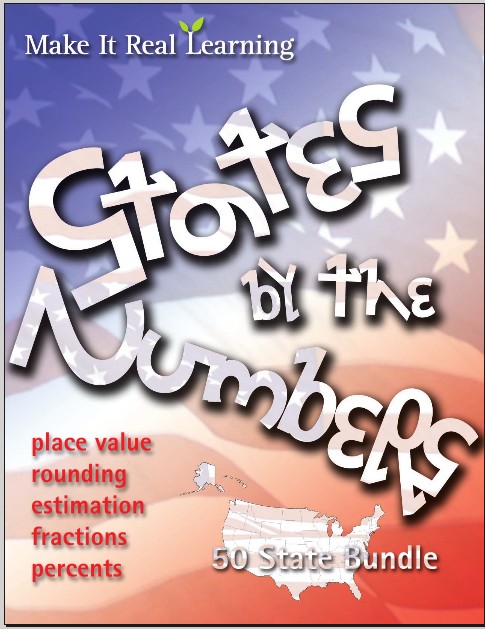
Unit studies in math - States by the Numbers

Make It Real Learning Arithmetic workbook
There is a book for
each state of the US.

Each book has 38 pages
(80 activities)

Price per book:
$2.99 PDF download


Free Sample (PDF):
North Dakota


Make It Real Learning States by the Numbers workbook bundle

Bundle of 50 workbooks $19.99
($0.40 per state)

Your order is secure
Shopper help at Kagi

buy now at Kagi

Recently I've had the pleasure of adding to MathMammoth.com a series of workbooks titled States by the Numbers, by Make It Real Learning company.

States by the Numbers is a series of workbooks where the problems in each workbook are based on data from the Census Bureau's 2008 Statistical Abstract of the United States.

These workbooks offer a real-data math adventure across the United States! You can use the workbook for your state along with other resources as a unit study about your own state, or your other favorite states. Meanwhile the students will also learn and practice place values, rounding, estimation, fractions and percentages.

There are 50 workbooks in the series — one for each state. Each workbook includes basic instruction and 80 practice problems. The problems can be used on grades 3-7; probably the best fit is for grades 4-6.

Since the activities teach both mathematics and social studies, many teachers and families enjoy using the workbooks to reinforce mathematics across the curriculum. Although the activities may be effectively used in a formal teaching setting, they are designed specifically for the independent learner.

Please see this page for a list of mathematical objectives in each of the books.

Jumat, 04 September 2009

Math Teachers At Play - Sep 4, 2009 edition

Welcome to another edition of "Math Teachers At Play"! It is again a very engaging and interesting assortment of posts, so feel free to stay a while and relax. Thank you for everyone who submitted!

We'll start out in the early years of kindergarten. What happens when a research mathematician goes into a kindergarten class? Something interesting, creative ... and best of all, kids love it. Go check Sequences and Creative Math for Kindergartners.

Next in line, kids in the elementary school (grades 1-4) spend a lot of time with math facts. Consider the fun Joey-Joey math game to help them practice!

We advance to 5th grade. With "Math Buddy" you can explore Fractions as part of life.

"Discrete Ideas" presents The Shortest Path - or mental math multiplication shortcuts for all of us. As a tie-in, I provide a PROOF for one of those shortcuts, which could be used as an exercise in algebra class.

Next, we advance to middle school. Quadrilateral Property Combo Chart shows how the Number Warrior finally untangled the dilemma of explaining the relationships between the quadrilaterals.

Tom from "I Want to Teach Forever" offers us an Erasing Debt Activity with a printable activity sheet. This is based on real-life data (actually offers he's received in the mail), and can get students really engaged in comparing the various options for paying back a debt. For middle school on up.

And lastly, time for miscellaneous math teaching articles.

What is the shape of the Earth? Do you think it's a sphere (a ball)? John Cook from "The Endeavour" answers the question. He also submitted Three algorithms for converting color to grayscale. It actually sounds pretty simple!

Well, now we get off math for a bit. An urban, high school mathematics teacher rambles on about something annoying... but gives us a glimpse to the issues teachers face.
From "Math and Logic Play" we get The Woman, Dog, and Flea riddle.
A complex-sounding question has a surprisingly simple answer.


We end the carnival with something fun. Here's something that most of us have probably not tried... using SKITS to teach math! From "I Want to Teach Forever"...

Thanks for reading - I hope you enjoyed something! Here's where you can submit to the next carnival.
Related Posts Plugin for WordPress, Blogger...